Lisa Sebesta, CFA
Principal/Consultant & MAI Chair
Mission-aligned investing has been part of our work since our founding. Some of our earliest clients sought to express concerns around apartheid-era South Africa and the Exxon Valdez oil spill through their portfolios, and we worked with them to translate those priorities into practical investment implementation. Since then, the landscape has broadened considerably, evolving from early socially responsible investing into a wider set of mission-aligned, sustainability, inclusion, impact, and place-based approaches.
While the terminology has changed, the underlying challenge has remained consistent. Most institutions do not struggle to articulate that mission matters. The harder questions are more specific: what mission alignment should mean for that organization, how it should show up in the portfolio, what tradeoffs are acceptable, and how governance bodies can move from broad interest to sustainable action. Those questions can look very different across endowments, foundations, community foundations, and other nonprofit investors.
In our experience, clients are best served when mission-aligned investing is approached strategically rather than reactively. That means starting with the institution’s own mission, values, and constraints; understanding the current portfolio; building stakeholder alignment; and then selecting implementation tools that match the client’s objectives. The goal is not to force every institution into the same framework, but to give each one a clearer path from values to portfolio decisions.
In this investment perspective, we outline how Prime Buchholz approaches mission-aligned investing through Pathways, explain why we view it as a strategic framework rather than a product, and describe how tools such as our annual manager survey, PrimePlus® analytics platform, stakeholder questionnaires, and implementation resources help clients move from discussion to action.
Why Strategy Matters
Mission-aligned investing can take many forms. For some clients, it starts with better transparency around manager practices and portfolio exposures. For others, it may involve revising investment policy language, setting manager expectations, applying screens, selecting managers with stronger alignment to institutional values, or dedicating capital to impact or place-based strategies. The menu of options is wide, but not every option is appropriate for every client.
That is why process matters. Institutions that jump too quickly to a tactic can create confusion around goals, accountability, or portfolio implications. Institutions that keep the conversation too conceptual can struggle to make progress at all. A strategic process helps avoid both outcomes by linking mission, governance, and implementation in a practical way.
It is important to recognize that mission alignment is often iterative. Many clients do not move directly from interest to a fully customized mandate. More often, they begin with greater awareness and transparency, then progress toward formalized goals, portfolio tilts, or more tailored implementation over time. A useful framework should support that progression.
The Role of Pathways
Pathways is our internal structure for supporting mission-aligned investing in a deliberate and organized way. It helps match each client’s level of interest and objectives with an appropriate implementation approach, rather than treating mission alignment as a binary choice.
At a high level, the framework recognizes a spectrum of approaches, from ‘Mission Aware’ to ‘Mission Tilt’ to ‘Outcomes-Oriented’ implementation. Some clients begin by wanting better data, clearer governance discussions, and a stronger understanding of what they already own. Others are ready to formalize mission goals and make more active portfolio changes. Others want customized mandates, dedicated sleeves, or more explicit monitoring tied to desired outcomes. Pathways helps organize these different levels of engagement into a practical continuum.
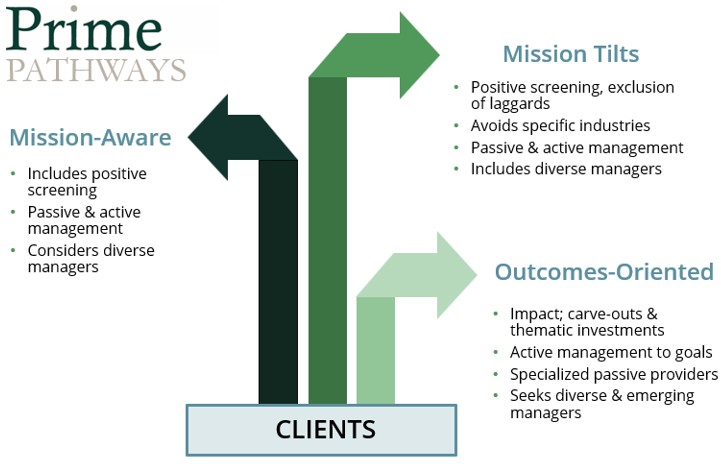
This matters because it reframes the discussion. Instead of asking whether a client is or is not “doing mission investing,” Pathways asks what type of support is most useful now and what next steps are realistic over time. That makes the work more strategic, more actionable, and better aligned with fiduciary and governance realities.
Tools That Support Decisions
A strategic mission alignment process requires tools that fit the client’s stage of implementation. We think about those tools through the Pathways lens.
Mission Aware
- Establish a baseline – Use PrimePlus® and portfolio reporting to understand current exposures, manager characteristics, and existing areas of alignment.
- Inform the discussion – Use annual manager survey results and client-ready education materials to support oversight and frame governance conversations.
- Build early governance alignment – Introduce mission alignment concepts, definitions, and sample policy language to help boards and committees discuss mission in an investment context.
Mission Tilt
- Formalize priorities – Use stakeholder surveys, mission related research, and sample IPS language to help define goals and identify practical portfolio changes.
- Evaluate implementation options – Review manager ideas, policy changes, portfolio tilts, and targeted adjustments that can improve alignment over time.
- Incorporate mission alignment into decision-making and reporting – Apply mission-related factors more directly in manager evaluation, portfolio reviews, and recommendation discussions.
Outcomes-Oriented
- Build tailored solutions – Design customized sleeves, outcome-driven mandates, and reporting frameworks for clients seeking more explicit mission implementation.
- Define measurable objectives – Link implementation to specific goals, monitoring standards, and reporting expectations tied to client priorities.
- Support ongoing oversight – Revisit outcomes, refine the action plan, and adjust implementation as mission goals and portfolio needs evolve.
These tools are meant to support tailored implementation rather than force uniformity. Some clients remain focused on transparency and governance. Others move toward more active implementation. Pathways gives structure to both, while allowing room for evolution as client priorities deepen or become more specific.
From Framework to Action
There is not one correct way to implement mission-aligned investing. The right approach depends on the institution’s mission, governance structure, portfolio size, liquidity needs, stakeholder priorities, and tolerance for benchmark deviation.
For some institutions, the most effective next step may be relatively modest but still meaningful: improving transparency, strengthening reporting, or updating policy language. For others, it may involve more specific implementation through manager selection, exclusions, stewardship, impact allocations, or place-based investments. What matters most is that the implementation follows from a deliberate process rather than a desire to adopt a label.
Our internal mission alignment materials have long emphasized a sequence that begins with education, moves through understanding the current portfolio and governance context, then develops a framework and action plan. We continue to believe that sequence is useful because it encourages forward progress without encouraging shortcuts. It also reinforces an important point: effective mission alignment is not just about finding aligned investments. It is about helping clients define success clearly enough to implement and monitor it over time.
That is also what makes Pathways evergreen. It is not dependent on a single market cycle, regulatory environment, or investment theme. It is an approach designed to help clients engage their mission fully.
Key Considerations
#1: Start with the Mission
Mission-aligned investing is most effective when it begins with the institution’s own values, priorities, and stakeholder context rather than industry terminology. Labels such as ESG, impact, or DEI can be useful shorthand, but they are not substitutes for clarity around what the client is actually trying to accomplish.
#2: Governance Often Determines Progress
In many cases, the key challenge is not investment selection but internal alignment. Trustees, staff, donors, and committees may agree on broad principles while differing on pace, priorities, or acceptable tradeoffs. A thoughtful governance process can make later implementation more durable and more practical.
#3: Baseline Analysis Matters
Before clients decide what to change, they should understand what they already own. Existing holdings, manager practices, and policy language often reveal both strengths and gaps. Establishing that baseline can make mission alignment discussions more specific and more actionable.
#4: Different Tools Serve Different Goals
Screening, manager selection, stakeholder engagement, impact allocations, and custom reporting can all be useful, but they do not accomplish the same thing. Institutions are generally better served when implementation tools are selected to match clearly defined objectives rather than broad enthusiasm alone.
#5: Monitor Alignment
Mission investing is not a one-time exercise. Ongoing review through manager research, PrimePlus®, stakeholder communication, and regular reporting of exposures and key metrics helps clients assess progress and adapt as priorities, portfolios, and external opportunities evolve.
Concluding Thoughts
Mission-aligned investing continues to evolve, but the central question remains consistent: how should an institution’s long-term capital reflect its long-term purpose? In our view, the answer is rarely found in a single screen, product, or reporting metric. It is more often found in a disciplined process that helps clients define priorities, evaluate tradeoffs, and implement thoughtfully.
That is the role Pathways is meant to play. Supported by our proprietary tools, internal resources, and decades of experience, it gives clients a practical framework for approaching mission alignment in a way that is strategic, flexible, and grounded in their own objectives. We believe that structure helps institutions move from values-driven conversations to portfolio decisions that are more intentional and more sustainable over time.
Please reach out with any questions.
All commentary contained within is the opinion of Prime Buchholz and is intended for informational purposes only; it does not constitute an offer, nor does it invite anyone to make an offer, to buy or sell securities. The content of this report is current as of the date indicated and is subject to change without notice. It does not take into account the specific investment objectives, financial situations, or needs of individual or institutional investors. Nothing herein should be construed as a guarantee of future results. All commentary contained within is the opinion of Prime Buchholz and is intended for informational purposes only and not investment advice.